The conversation around AI enablement often focuses on training models, fine-tuning prompts, improving usage metrics and optimizing workflows. But here’s an uncomfortable truth: if your organization struggles with innovation today, AI won’t magically fix that tomorrow.
The real barrier to AI adoption isn’t technical—it’s cultural. And it starts with something surprisingly basic: the ability to ask good questions.
The Question Problem
Consider a typical organization where employees have performed the same tasks for years without improvement. No automation, no optimization, no elimination of redundant steps. Now introduce AI into this environment. What happens?
Nothing changes.
Why? Because AI doesn’t proactively identify problems—people do. If nobody thinks to ask “Could this process be optimized?” then AI will never get the chance to suggest improvements. The tool is only as good as the questions we pose to it.
Some people simply won’t think to ask. Others actively resist automation because they’re comfortable in their current roles and processes. Large organizations, in particular, often lack the dynamism to handle the changes that AI-driven optimization would require.
The Pattern Recognition Paradox
Here’s another layer to consider: AI’s primary function is pattern recognition and prediction. The solutions it proposes could typically be generated without AI—through human analysis, brainstorming, or consultancy. So if nobody implemented these improvements before AI existed, maybe the problem wasn’t the absence of AI. Maybe it was the absence of diagnostic thinking, questioning culture, or willingness to implement change.
This is where we need to shift perspective.
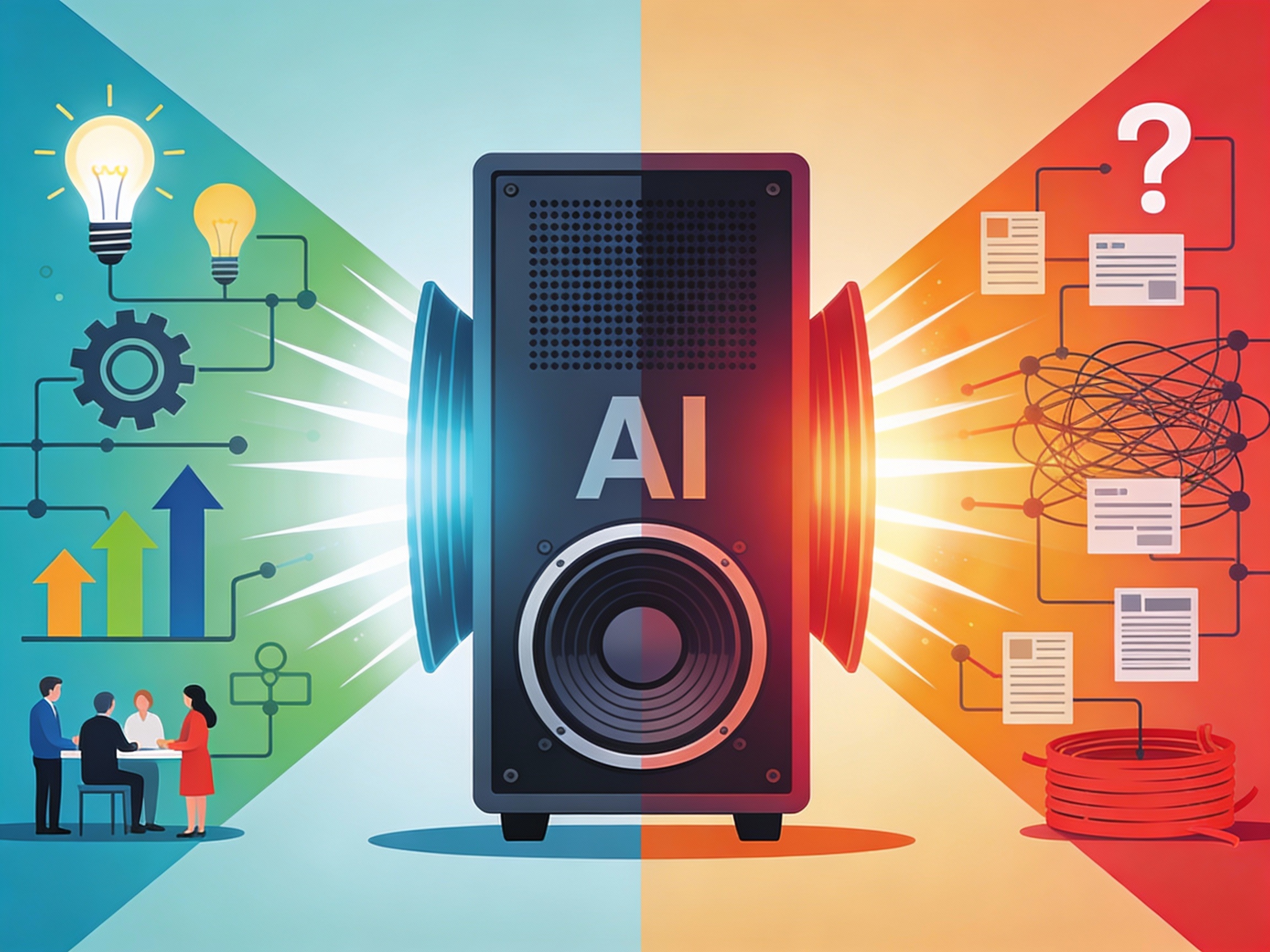
AI isn’t a magic wand that transforms dysfunctional organizations into efficient ones.
It’s an amplifier. It amplifies existing capabilities—and existing limitations.
The Learning Mindset Advantage
But let’s not be entirely pessimistic. Many professionals are continuously learning, actively improving their work, adopting new approaches, and testing new solutions. They ask questions readily and verify answers critically. For these individuals, AI becomes a force multiplier.
When they have an idea, they don’t need to wait for a colleague or specialist in a particular programming language to test it. They don’t need to read entire documentation sets—they ask precise questions and get exactly what they need. They iterate faster, experiment more freely, and solve problems more creatively.
This is the real value proposition of AI: accelerating the already curious, the already motivated, the already skilled at critical thinking.
The Management Multiplier
Organizations often approach AI adoption with a narrow focus on development efficiency, setting targets like “reduce coding time by 30%” or “increase output by X%.” This overlooks a fundamental reality: writing code represents less than 40% of software development work. The rest involves requirements gathering, design discussions, code reviews, debugging, deployment, and collaboration.
Developers tend to adopt AI tools quickly—they’re naturally inclined toward automation and efficiency. The real opportunity, however, lies elsewhere in the organization. The critical function isn’t just enabling developers to code faster; it’s ensuring that managers can effectively guide, support, and optimize their teams’ entire workflow.
This means investing in management capabilities: training leaders to ask better questions, make informed technical decisions, remove blockers, and create environments where knowledge workers thrive. Critically, this includes establishing robust knowledge management practices—especially important in organizations with high turnover, contractors rotating between projects, or Gen-Z professionals exploring different opportunities. When institutional knowledge walks out the door every few months, AI becomes both a challenge and an opportunity: it can help capture and retrieve knowledge, but only if leaders understand how to structure, prompt, and maintain these systems effectively.
When we talk about “managing” in this context, we mean the full spectrum—motivating, supporting, protecting, and enabling teams to do their best work. AI can assist with many technical tasks, but effective people management remains the ultimate leverage point for organizational performance.
Rethinking Training Priorities
So what should organizations focus on? Instead of rushing to “teach AI” or implement the latest models, invest in teaching people to think differently:
- How to identify problems worth solving
- How to formulate precise, testable questions
- How to verify answers critically rather than accepting them blindly
- How to iterate on solutions systematically
These skills matter because the future of work isn’t about following instructions—AI can do that effortlessly, provided managers can formulate instructions precisely.
The value lies in the thinking that happens before the instruction, in the questions that identify opportunities, and in the judgment that validates solutions.
The Hidden Metric
Perhaps the most interesting insight is this: metrics from AI tools might already reveal who your most valuable team members are. Usage patterns, question complexity, solution iteration rates—these could be unobtrusive indicators of curiosity, problem-solving ability, and learning orientation. The people actively engaging with AI to explore solutions, learn new approaches, and optimize workflows are demonstrating exactly the mindset that will remain valuable as automation advances.
The Foundation Problem
AI’s promise is clear: boost processes, reduce coordination overhead, and multiply the impact of talented individuals. But this assumes there’s something substantial to boost in the first place.
Consider an uncomfortable scenario: what if the organizational structure itself lacks the foundation for improvement? In some environments, leadership attention flows primarily toward internal positioning rather than team development. Energy gets consumed by navigating organizational politics, maintaining comfortable equilibria, or waiting for the next restructuring rather than building capability and delivering value.
This isn’t a criticism of individuals—it’s a systems problem. When incentive structures reward internal maneuvering over team growth, or when leaders lack clear frameworks for developing knowledge workers, even the most powerful AI tools won’t create meaningful change. They’ll simply automate existing patterns, some of which may not serve the organization’s stated goals.
The solution requires honest organizational assessment: Are leaders equipped and incentivized to genuinely develop their teams? Do management practices focus on creating value or maintaining structure? Until these foundational questions are addressed, AI implementation will likely deliver disappointing returns, not because the technology fails, but because it’s being deployed in an environment that isn’t ready to capitalize on it.
The Retention vs. Replacement Question
Organizations face a fundamental choice in the AI era: invest in people who can manage AI effectively, or use AI to manage people churn. The data increasingly supports the former.
While contractor rotation and frequent job changes might appear to optimize costs, they create a knowledge management challenge that AI can’t fully solve. AI amplifies expertise—it doesn’t replace it. An experienced team member using AI will always outperform a rotating cast of contractors using AI to compensate for missing context, because experienced people know which questions matter, recognize flawed outputs, and understand organizational nuances that can’t be captured in documentation.
This shift requires rethinking incentives. If experienced professionals are rewarded only for individual output, they have little motivation to mentor others or transfer knowledge. If culture values short-term cost optimization over deep institutional knowledge, AI becomes a band-aid rather than a force multiplier.
The organizations extracting maximum value from AI will be those where experienced people are rewarded for mentorship, not just output—where culture values deep knowledge over cost optimization. They’ll invest in succession planning that involves active knowledge transfer, not hoping that AI or documentation fills gaps when people leave. They’ll recognize that building a team that can effectively manage AI delivers better ROI than constantly managing the churn AI is supposed to compensate for.
Building a Questioning Culture
To truly enable AI in your organization, focus on culture change first:
Create psychological safety where questioning established processes is encouraged, not punished. Reward improvement initiatives, even failed experiments. Value learning orientation over tenure. Recognize that “we’ve always done it this way” is a red flag, not a defense.
Train people to articulate problems clearly, break down complex challenges into components, and evaluate proposed solutions critically. These skills make AI useful rather than just present.
Building this culture requires rethinking traditional metrics and incentives. If experienced team members are rewarded solely for individual output, they have little reason to mentor others or invest in knowledge transfer. If the culture values short-term cost optimization over deep organizational knowledge, AI becomes a band-aid for dysfunction rather than an amplifier of capability.
Consider instead: What if organizations measured and rewarded mentorship as seriously as productivity? What if succession planning meant deliberate, active knowledge transfer rather than hoping documentation or AI fills the gaps when someone leaves? The companies that will extract the most value from AI won’t be those with the lowest headcount costs—they’ll be those that invested in stable, knowledgeable teams who can teach AI systems, verify their outputs, and mentor the next generation in doing the same.
The Real Investment
AI adoption isn’t primarily a technology decision—it’s a people decision. The organizations that will benefit most aren’t those with the best models, but those with teams who know how to ask good questions, verify answers critically, and transfer that knowledge to others.
The technology is ready. The question is whether your organization is.