
In the age of AI, your imagination is the only real constraint. That sentence gets thrown around a lot — here’s what it looked like in practice for me last Sunday.
The Science Museum Problem
I took my daughter to the Copernicus Science Centre in Warsaw — highly recommended, by the way, one of the best science museums in Europe. Among hundreds of exhibits she fell in love with a mechanical memory game: a row of physical buttons that light up in a sequence you then have to repeat. Classic “Simon”-style gameplay, wooden, tactile, addictive.
So naturally I promised we’d build our own on a Raspberry Pi. There was just one problem: it was Sunday, and I didn’t have eight buttons at home. Not eight LEDs either. The shops were closed.
But I had an AI agent in my terminal, a Cloudflare account, and a spare subdomain. So instead I asked it to build the whole thing end-to-end — code, git repo, GitHub, deployment, custom domain.
The One Prompt
This is the actual prompt I wrote (lightly cleaned up). It’s long on purpose — and that’s the point:
Create a new page/app - a simple game - something like stekikuby.orpi.pl
from the kuba-s-catch-mania folder.

Guidelines:
1. Domain: memory-game.orpi.pl
2. Title: "Check your memory"
3. Fullscreen: a row of 8 big blue round buttons with two score fields
   in large boxes above them; numbers 1-8 under the buttons

The buttons light up in a sequence and the user repeats it.
Start short - each round adds one button.

e.g. button 2 lights up and goes dark - then "Your turn" is shown and a
timer starts (10 seconds - plan the hard-mode limit so it scales with
sequence length; a user memorizing 20 buttons shouldn't get only 5
seconds). Several languages will be selectable: pl/en/es/de/fr/uk.

The user clicks button 2 and gets a point - sees the score above the
buttons plus the best score - stored locally in the session together
with the player's name (ask for the name on start; ask whether it's a
public computer - on public ones, wipe the session after 5 minutes).

The system lights up 2 and 8. The user clicks 2 and 8. The system shows
2, 8, 1. Etc. It validates the sequence: correct -> show a sequence one
element longer; wrong -> game over; if score > max, overwrite it.

Build it in HTML/JS or possibly Next.js - I want to host on my Cloudflare

First init a git repo and push to GitHub - from there we'll deploy.

Prepare the game for selectable themes - it's for kids, so we'll want to
change the background and button style/colour - for now a solid
background and uniform round blue buttons.

Make a plan and ask questions if anything is unclear.
Playable on phone (landscape), iPad, and desktop.
Read it again. Notice it’s not “make me a memory game.” It specifies the layout, the exact game loop, the scoring model, the session semantics (including a privacy edge case — public computers), i18n scope, the deployment target, future extensibility (themes), and it explicitly invites the agent to plan and ask questions first. That last line saved a whole round-trip: the agent asked four good questions (stack, hosting, timer model, repo name) and then executed.
What Came Out
The agent picked Vite + React + TypeScript + Tailwind — matching the reference project it found in a neighbouring folder — and delivered:
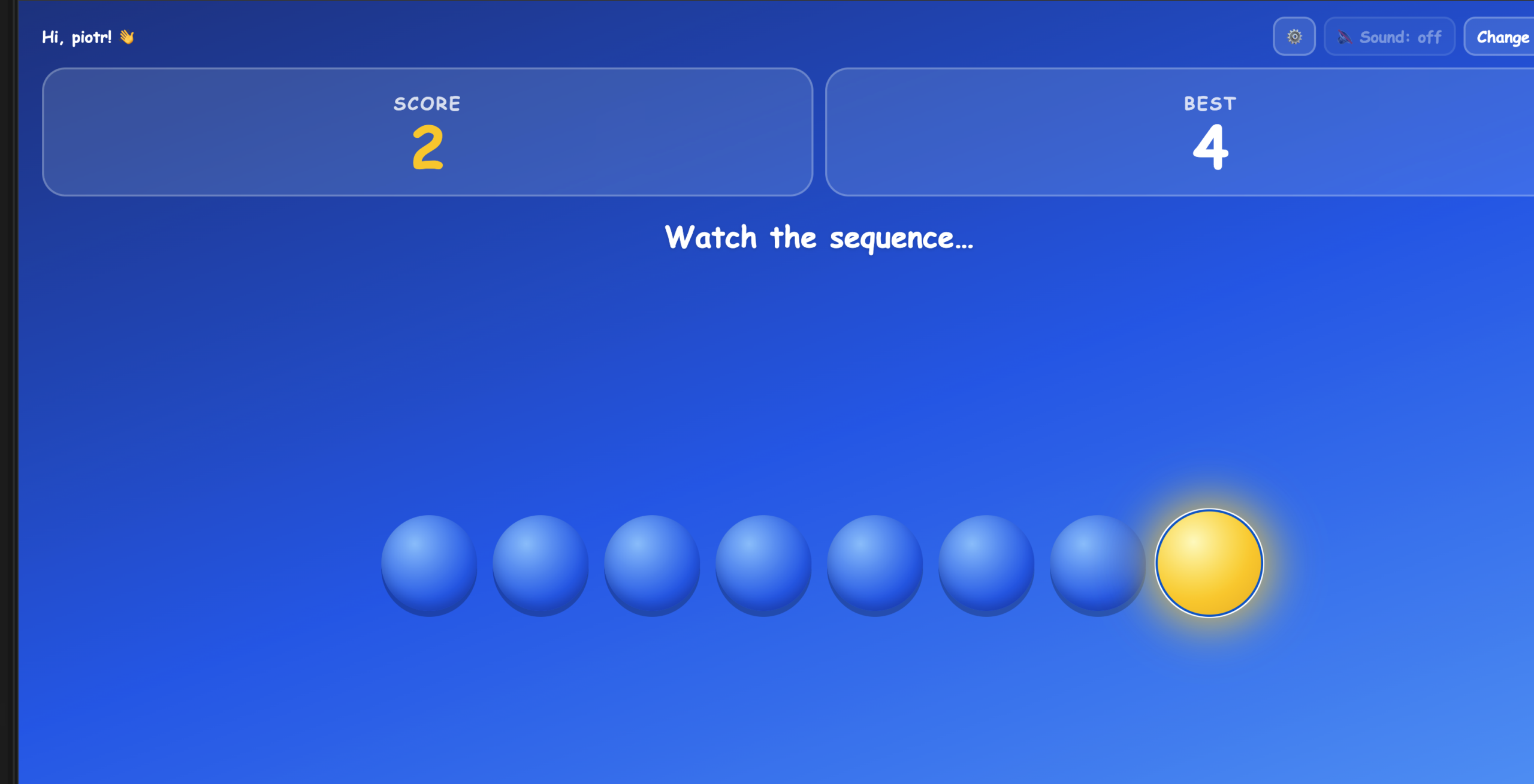
- A full Simon-style game: 8 glowing buttons, sequence playback with per-button tones, scoring, best-score persistence
- A start screen: player name, public-computer checkbox (auto-wipe after 5 idle minutes), language picker (6 languages), theme picker (4 colour themes), difficulty selector
- A 3-2-1 countdown, “watch / your turn” states, timeout handling, and a game-over screen
git init, first commit, a brand-new GitHub repo, and a live deployment on Cloudflare Pages viawrangler, withmemory-game.orpi.plattached to the project through the Cloudflare API
The only thing it couldn’t do was write DNS records (my wrangler OAuth token lacks the DNS scope) — it told me exactly which CNAME to add, verified it once propagated, and confirmed HTTPS was serving. One manual step in an otherwise fully autonomous pipeline.
The Tuning Prompts
A first version is never the final version. Playability tuning was a handful of short follow-ups:
"Before the game starts, count down 3, 2, 1 — right now I click 'play' and miss the first flash. Each button should stay lit for 1 second, with half a second of darkness between them."

"After the sequence is shown, there's too long a pause before I can click — check what the code does. Also, when a player times out, flash the missed clicks — you only show the reveal on a wrong press."

"Score should equal the memorized sequence length, not total clicks.
And add a Settings button where I can reset the record."

"Make 4 difficulty modes. Two we have; next without sounds; next without sounds and without the numbers."
Each one shipped, got committed, pushed, and redeployed. Notice how the feedback is behavioural, not technical — “there’s too long a pause, check what the code does.” The agent dug into its own timing logic, found a hidden gap + 300ms trailing delay, and cut it to ~150ms.
The Pencil and Paper Thesis
Here’s the thing: everyone has AI now, the same way anyone can buy a pencil and paper at a shop. The tool itself is no longer the differentiator. What differs is how efficiently people wield it. Some get a finished product; others burn an afternoon just formulating the task.
This whole thing took a few minutes of my time — and most of that speed came from preparation, not luck:
- Access already configured. My
wranglerwas logged into Cloudflare,ghwas authenticated to GitHub. Zero time on auth. - A reference architecture. The agent cloned conventions from an existing project in a sibling folder. Is Vite+React+TS overkill for a memory game? Probably — but consistency is free, and we plan to extend it.
- A concrete spec. I described the game loop from memory of the museum exhibit, including edge cases, instead of hoping the model would guess.
None of that is special knowledge. It’s just thinking about what you want before asking for how to build it — the exact same skill that separates a clear requirements doc from a vague one. AI didn’t lower the bar on knowing what you want; it raised the reward for articulating it.
Go Play
The game is live, free, and works on your phone (landscape), tablet, or laptop.👉 Play at memory-game.orpi.pl
Source code: github.com/plusz/check-your-memory — fork it, add your own themes (it’s built for that), or build something entirely different with your own one-prompt project.
My daughter approves. The Raspberry Pi version is still on the roadmap — but now the buttons have something to live up to.